



Strategic Observations | IN2China Pathway
This article is part of the IN2China Pathway series, exploring structured approaches to UK–China engagement.

China’s digital environment operates as an integrated system, where infrastructure, platforms, and user interaction are closely interconnected.
As UK life sciences organisations explore international engagement, China’s digital environment is receiving increasing attention — particularly as a potential entry point for market understanding, early partnership activity, and eventually, commercial pathway development. Yet the nature of that environment is frequently misread, with consequences that extend beyond the technical.
While this perspective is framed in the context of UK organisations engaging with China, the underlying system dynamics are equally relevant in the opposite direction, reflecting the shared complexity of cross-border engagement.
From a governance perspective, including within the EFEC UK–China Life Sciences Innovation Hub’s ongoing work, engagement with China’s digital ecosystem is not simply a question of market access or platform capability. It is, more fundamentally, a question of underlying structure, regulatory alignment, and operational readiness.
A Structurally Different System
Conversations with operators who have built and sustained digital operations within China consistently point to a foundational distinction: China’s digital environment is not a variation of Western models. It is a structurally different ecosystem.
Rather than a fragmented landscape of separate tools, it operates as a highly integrated system where communication, commerce, and service delivery are embedded within a small number of dominant platforms. For life sciences organisations, this has direct implications for how clinical communication, patient engagement, hospital procurement workflows, and regulatory submissions are conducted.
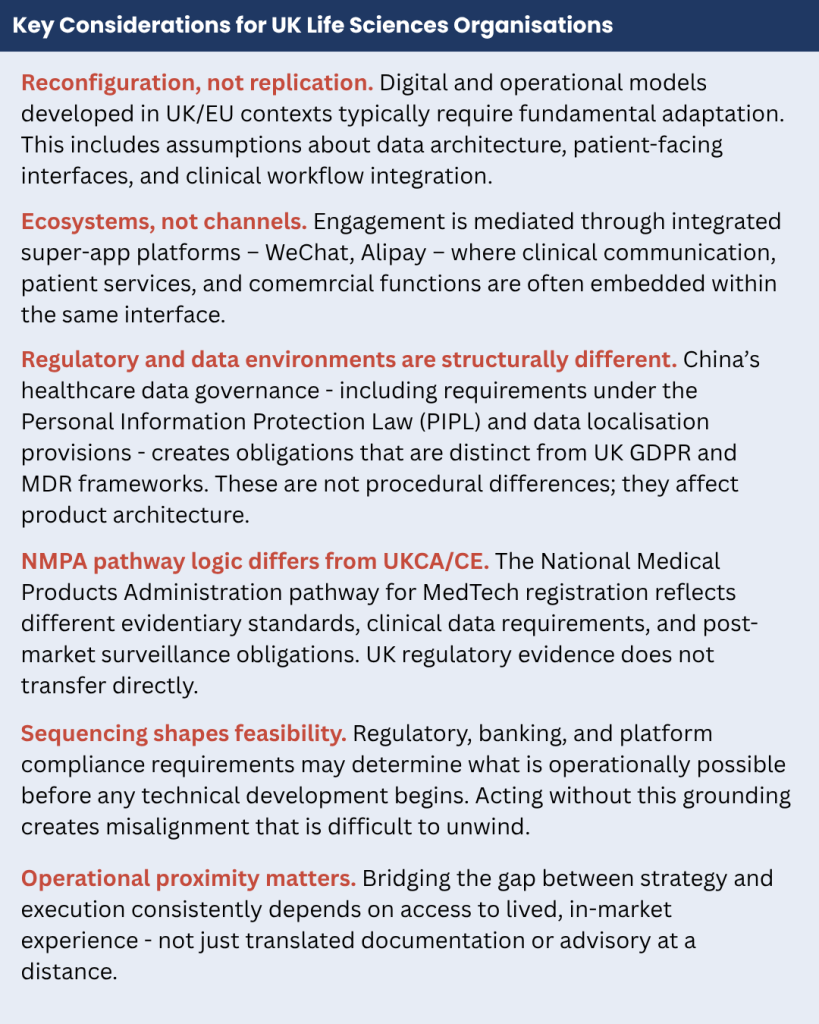
In many sectors, service discovery, provider communication, and after-sales support are mediated through super-apps such as WeChat or Alipay. Within these environments, functionality is delivered through embedded mini-programme ecosystems, enabling organisations to operate transactional and clinical-adjacent services without standalone applications or external app stores. For a UK MedTech company accustomed to dispersed digital infrastructure — separate CRM, analytics, regulatory submission, and clinical communication systems — this requires not only technical reconfiguration but a re-examination of organisational assumptions about user behaviour, data visibility, and operational control.
Healthcare Data Governance: Not a Procedural Difference
For life sciences and MedTech organisations specifically, China’s data governance architecture introduces obligations that are structurally distinct from UK and EU frameworks. China’s Personal Information Protection Law (PIPL), the Data Security Law, and sector-specific healthcare data regulations establish data localisation requirements, cross-border transfer restrictions, and security assessment obligations that differ materially from UK GDPR provisions.
These are not simply compliance items to be addressed at the point of market entry. They affect product architecture decisions, cloud infrastructure choices, clinical data collection design, and the structure of any collaboration involving patient-level data. For organisations that have designed their data environments around EU MDR or UKCA standards, the assumption that existing data governance frameworks can be extended or adapted with marginal adjustment is a significant source of risk.
In practice, this means that data governance readiness — including legal entity structure, data residency, and cross-border transfer protocols — must be considered as a precondition of engagement, not a consequence of it.
Regulatory Pathway Logic
China’s National Medical Products Administration (NMPA) pathway for medical device registration reflects different evidentiary standards, clinical data requirements, and post-market surveillance obligations than those that apply under UKCA or CE marking. Regulatory evidence generated in UK or EU clinical environments does not transfer directly, and in many categories, additional in-country clinical data is required.
This is not a barrier unique to China; comparable dynamics apply in other major regulated markets. What makes it operationally significant is the frequency with which it is treated as a downstream consideration, to be addressed once a partnership or commercial intent has been established. In practice, regulatory pathway feasibility should inform the decision to engage, not follow from it.
The Gap Between Strategic Intent and Operational Readiness
A common starting point for UK organisations is to approach international expansion as a process of extending existing models into new geographies. In the case of China, this approach rarely translates directly.
The perceived accessibility of digital tools — and the apparent familiarity of platforms like WeChat to those who have encountered them in personal contexts — can create a false sense of immediacy. In practice, effective engagement often depends on careful sequencing, local understanding, and sustained relationship-building. Foundational requirements such as licensing, banking infrastructure, platform integration compliance, and local entity structure may determine what is operationally possible before any technical or commercial development begins.
There is also a consistent gap between expressions of intent and the capability required to execute within a different system. “Entering the China market” is not a strategy. It is a statement of direction that requires its own assumptions, partners, sequencing, and governance framework to become actionable.
A Governance Orientation
From a governance perspective, this shifts the emphasis from opportunity to preparedness. Within the Hub’s approach, this includes:
- Qualification before connection — ensuring that organisations are engaging for the right reasons, at the right stage of readiness
- Structured exploration — enabling informed understanding before commitment, including regulatory and data architecture assessment
- Clear decision frameworks — supporting proportionate and reversible steps that reflect system-level differences
- Engagement with experienced operators — while maintaining appropriate governance and accountability boundaries
This orientation does not imply hesitation or caution for its own sake. It reflects a disciplined approach to cross-border engagement in a regulated sector, where the consequences of misalignment — regulatory, reputational, or operational — are not easily unwound.
As global conditions continue to evolve, the ability to navigate structurally different digital and regulatory environments with clarity, discipline, and appropriate pacing is becoming a meaningful differentiator for life sciences organisations with serious international ambitions. The question is not only whether to engage, but how to do so in a way that is aligned, proportionate, and sustainable.
Disclaimer
This article reflects the working perspectives of the EFEC UK–China Life Sciences Innovation Hub and is intended to support informed discussion. It does not constitute advice or represent the official positions of any affiliated organisations or partners.