



When systems drift apart: what Unity’s China shift reveals for UK–EU–China life sciences collaboration.
Unity’s decision to delist China-based developers from its global Asset Store and explore a sale of its China business has sparked debate across the technology sector. While the move sits within the gaming industry, it reflects a broader dynamic that increasingly affects life sciences and healthcare collaboration.
In software ecosystems, a single platform decision can instantly reshape the environment for developers. Access to tools, distribution channels and global markets can change almost overnight.
Life sciences rarely shifts that quickly. Instead of platforms, the system is shaped by regulatory frameworks, clinical evidence standards and national health systems. Yet the long-term impact of divergence between regulatory systems can be just as significant.
Across the UK and Europe, regulatory expectations are evolving through frameworks such as the EU Medical Device Regulation (MDR), the UK’s post-Brexit regulatory pathway, and the EU AI Act. These regimes create complex but relatively transparent expectations around safety, data governance, and evidence generation.
China’s regulatory system is also undergoing rapid transformation. Reforms led by the National Medical Products Administration (NMPA), new rules on clinical data and real-world evidence, and evolving cross-border data governance frameworks are reshaping how Chinese biotechs conduct trials and engage international markets.
What is emerging is not a single market closing, but a gradual drift between regulatory systems.
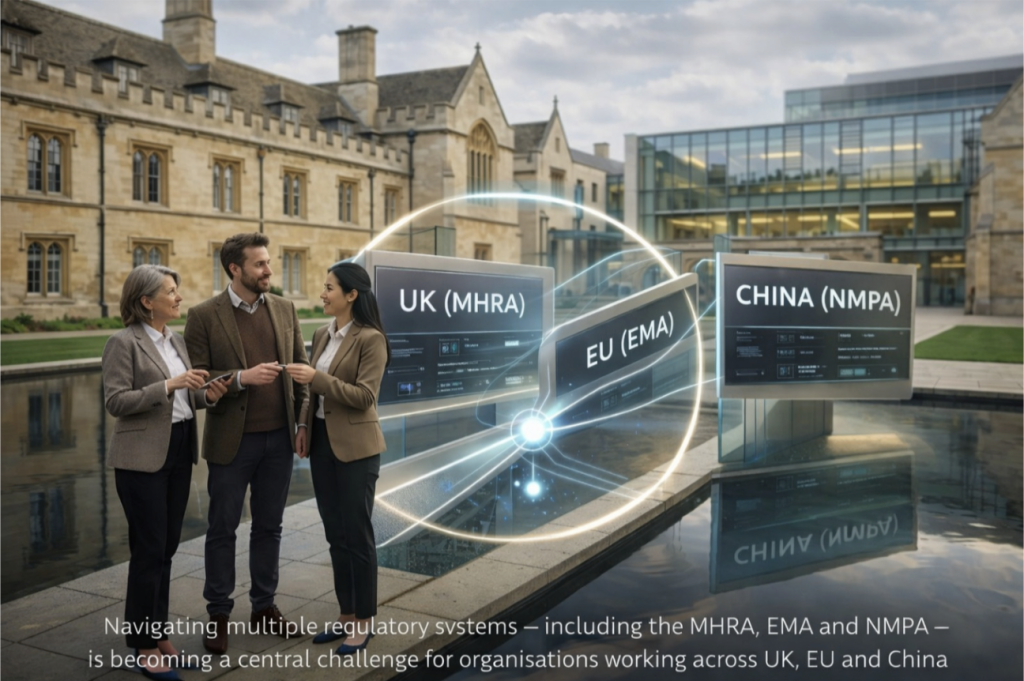
For organisations operating across the UK, EU, and China, this creates practical challenges that extend well beyond policy headlines.
At EFEC – Excellence First Enterprise Consultancy – we see boards and leadership teams increasingly asking three questions.
1. Can scientific programmes remain coherent across multiple regulatory environments?
Clinical trials, digital health platforms, and AI-enabled diagnostics often need to satisfy different
expectations simultaneously.
2. Do collaborations include governance structures that allow partnerships to pause, adapt, or re-sequence if regulatory or geopolitical conditions shift?
Resilience increasingly depends on designing reversibility into programmes from the start.
3. Are organisations developing “bridge capability”?
Teams who understand the regulatory logic of the MHRA and EMA while also navigating NMPA practice will play a critical role in enabling responsible collaboration.
In technology sectors, platform decisions can accelerate decoupling overnight. In life sciences, divergence tends to emerge more slowly through regulation, clinical evidence standards, and data governance.
But the strategic implication is similar: collaboration becomes harder unless organisations deliberately design for it.
Clinical development, licensing strategies, AI-enabled research and digital health innovation all
depend on the ability to translate not only language, but also standards of evidence, regulatory expectations and institutional cultures.
This is one of the areas where the EFEC UK–China Life Sciences Innovation Hub focuses its work: supporting organisations in the UK, EU and China to navigate increasing regulatory complexity while maintaining scientific integrity and trusted collaboration.
Unity’s situation may belong to the gaming industry, but the underlying question applies equally to life sciences.
As systems gradually drift apart, the organisations that succeed will be those able to design collaboration deliberately — rather than assuming alignment will continue by default.
EFEC Hub Disclaimer
This article reflects the working perspectives of the EFEC UK–China Life Sciences Innovation Hub and is intended to support informed discussion. It does not constitute advice or represent the official positions of any affiliated organisations or partners.