



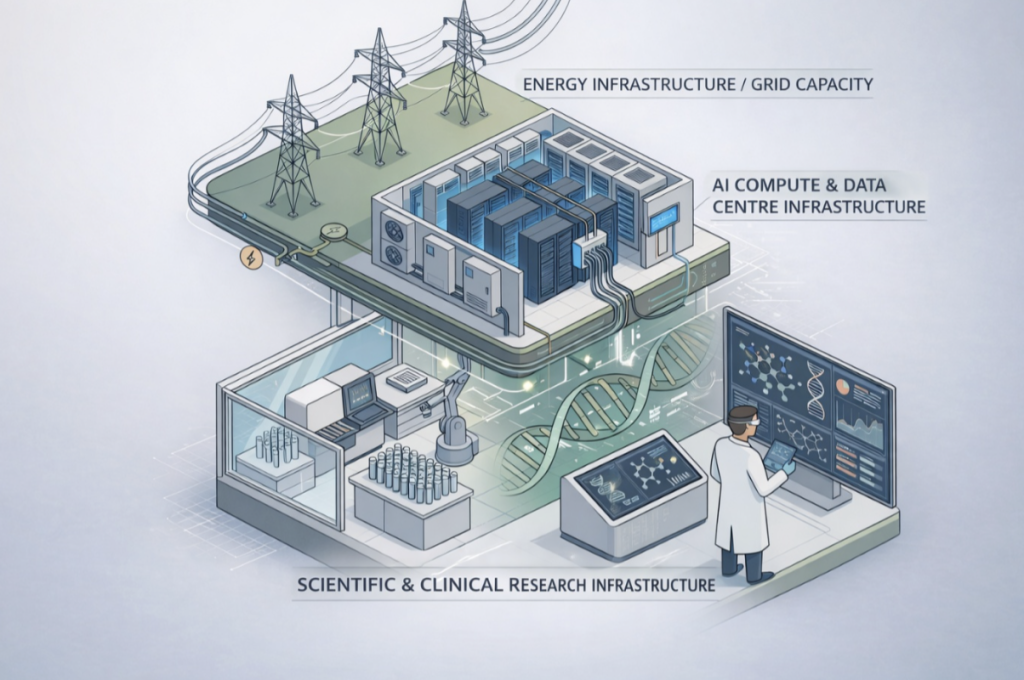
Illustration showing the convergence of energy infrastructure, AI compute capacity, and scientific research environments. As electricity grids, data centres, and research computing become increasingly interconnected, infrastructure readiness is beginning to shape where life sciences innovation ecosystems can develop.
Recent proposals to fast-track data centres through the UK’s electricity grid connection queue signal a structural shift in how digital, energy, and scientific infrastructure are beginning to converge.
While much of the public debate focuses on AI competitiveness and digital infrastructure, the
implications extend beyond the technology sector. For life sciences ecosystems — particularly those operating across the UK and China — the more important question may not simply be how much compute capacity is built, but what kind of infrastructure it is, and how it is governed.
Grid constraints as a strategic bottleneck
The UK electricity grid is currently facing a substantial backlog of connection requests. In the six months to June 2025 alone, applications to the transmission network reportedly increased by more than 400%, driven in large part by demand for new data centres linked to the government’s AI ambitions.
The result has been a queue so large that genuinely ready projects risk being delayed for years.
Government proposals now under consultation aim to reform this system by prioritising projects considered strategically important and ready to build. In practice, this means that AI data centres, AI Growth Zones, and electrified industrial projects may move more quickly through the connection process.
For policymakers, this reflects an increasingly clear recognition: AI compute capacity is becoming a form of national infrastructure, not simply a commercial digital service.
But for sectors such as life sciences, this shift raises additional questions.
Three infrastructures becoming one
What we are observing is a broader convergence between three forms of infrastructure that historically evolved largely in parallel:
• Energy infrastructure — electricity generation, transmission, and grid capacity
• Digital infrastructure — data centres, AI compute and connectivity
• Scientific infrastructure — research computing, clinical data platforms, and laboratory systems
Today, these systems are becoming closely intertwined. Decisions about one increasingly constrain or enable the others.
Where AI data centres and research facilities develop in a coordinated way, life sciences innovators may gain improved access to advanced computing resources. Where hyperscale facilities absorb available grid capacity without coordination, research institutions, hospitals, and biotech companies may encounter new constraints — particularly in regions where electricity networks are already under pressure.
As data-intensive science expands, this convergence is likely to influence where research programmes, clinical data platforms, and innovation hubs are located.
Compute capacity is not clinical infrastructure
One distinction is particularly important for life sciences.
The sector does not simply require more data centres. It requires data centres that operate within appropriate governance frameworks.
Health data in the UK sits within governance systems that extend well beyond standard data protection regulation. NHS-related data environments must meet strict requirements around accountability, auditability, and stewardship of patient information.
In this context, data sovereignty means more than knowing where data is physically stored. It involves understanding who controls the infrastructure, under what legal framework, and with what level of clinical accountability.
Generic commercial data centres designed for enterprise AI workloads are not always configured with these governance requirements in mind.
At the same time, some of the locations prioritised for new AI infrastructure are geographically separate from the UK’s main life sciences research clusters in London, Oxford, and Cambridge. While this may support broader digital infrastructure goals, it does not automatically strengthen the digital foundations of clinical research ecosystems.
Priority grid access may accelerate infrastructure deployment. It does not necessarily resolve
questions about whether that infrastructure is suited to clinical and research collaboration.
Implications for international collaboration
For international investors and ecosystem stakeholders — including those engaged in UK–China life sciences collaboration — infrastructure readiness is becoming a more visible factor in strategic decision-making.
Beyond scientific excellence and regulatory frameworks, organisations may increasingly consider:
• access to AI compute resources
• reliability of energy supply for data-intensive research
• governance frameworks for health data infrastructure
These factors are beginning to shape decisions about research partnerships, site selection, and long-term ecosystem development, particularly as countries compete to host AI-enabled
scientific infrastructure.
For organisations navigating both UK and Chinese innovation environments, understanding how grid reform intersects with digital infrastructure and data governance will become an
increasingly important part of risk management and opportunity assessment.
EFEC Hub observation
The rapid expansion of AI infrastructure highlights an important point: scientific ecosystems depend not only on talent and investment, but also on the infrastructure systems that enable modern discovery.
As AI, energy, and life sciences continue to converge, governance frameworks that support responsible and coordinated infrastructure development will become increasingly important — particularly for organisations working across different regulatory and political environments.
A useful distinction to keep in mind is that infrastructure capacity and infrastructure readiness are not the same thing.
For those planning long-term engagement in UK life sciences ecosystems, specifying the
infrastructure requirements of research and clinical collaboration — including governance, energy resilience, and computer access — may become an increasingly important part of strategic planning.
At the EFEC UK–China Life Sciences Innovation Hub, we see growing interest among investors, research institutions, and policymakers in understanding how these infrastructure dynamics shape the resilience and long-term impact of cross-border life sciences collaboration.
EFEC Hub Disclaimer
This article reflects the working perspectives of the EFEC UK–China Life Sciences Innovation Hub and is intended to support informed discussion. It does not constitute advice or represent the official positions of any affiliated organisations or partners.