



Prepared by Excellence First Enterprise Consultancy (EFEC)
Executive Summary
Why ESG Matters in Cross-Border Life Sciences
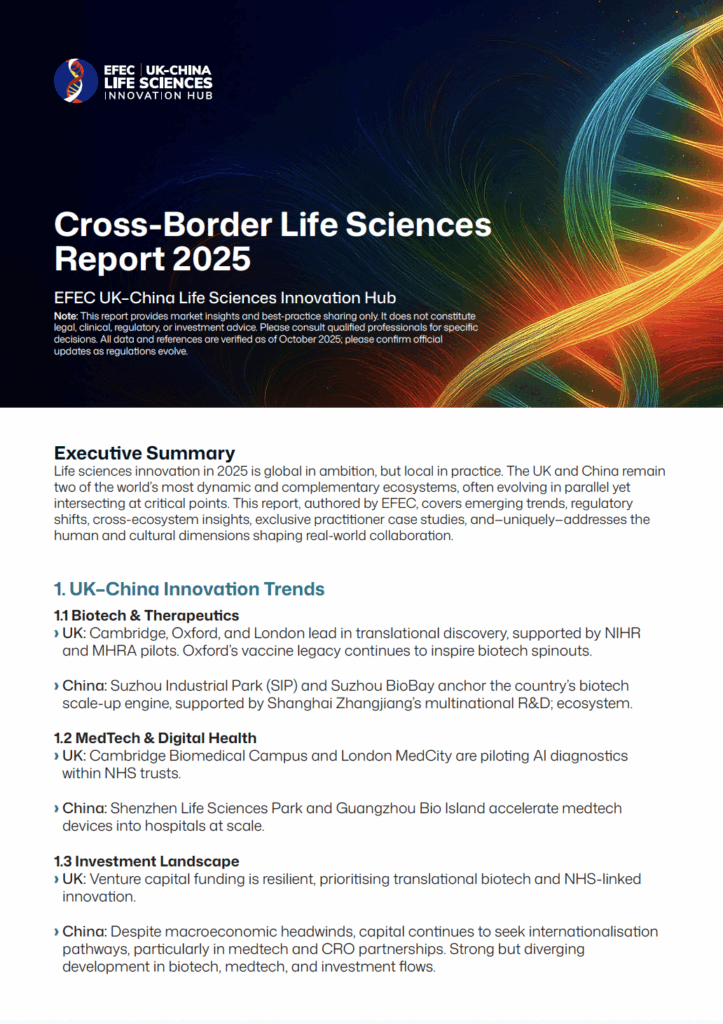
Life sciences innovation in 2025 is global in ambition, but local in practice. The UK and China remain two of the world’s most dynamic and complementary ecosystems, often evolving in parallel yet intersecting at critical points. This report, authored by EFEC, covers emerging trends, regulatory shifts, cross-ecosystem insights, exclusive practitioner case studies, and—uniquely—addresses the human and cultural dimensions shaping real-world collaboration.
1. UK–China Innovation Trends
1.1 Biotech & Therapeutics
- UK: Cambridge, Oxford, and London lead in translational discovery, supported by NIHR and MHRA pilots. Oxford’s vaccine legacy continues to inspire biotech spinouts.
- China: Suzhou Industrial Park (SIP) and Suzhou BioBay anchor the country’s biotech scale-up engine, supported by Shanghai Zhangjiang’s multinational R&D; ecosystem.
1.2 MedTech & Digital Health
- UK: Cambridge Biomedical Campus and London MedCity are piloting AI diagnostics within NHS trusts.
- China: Shenzhen Life Sciences Park and Guangzhou Bio Island accelerate medtech devices into hospitals at scale.
1.3 Investment Landscape
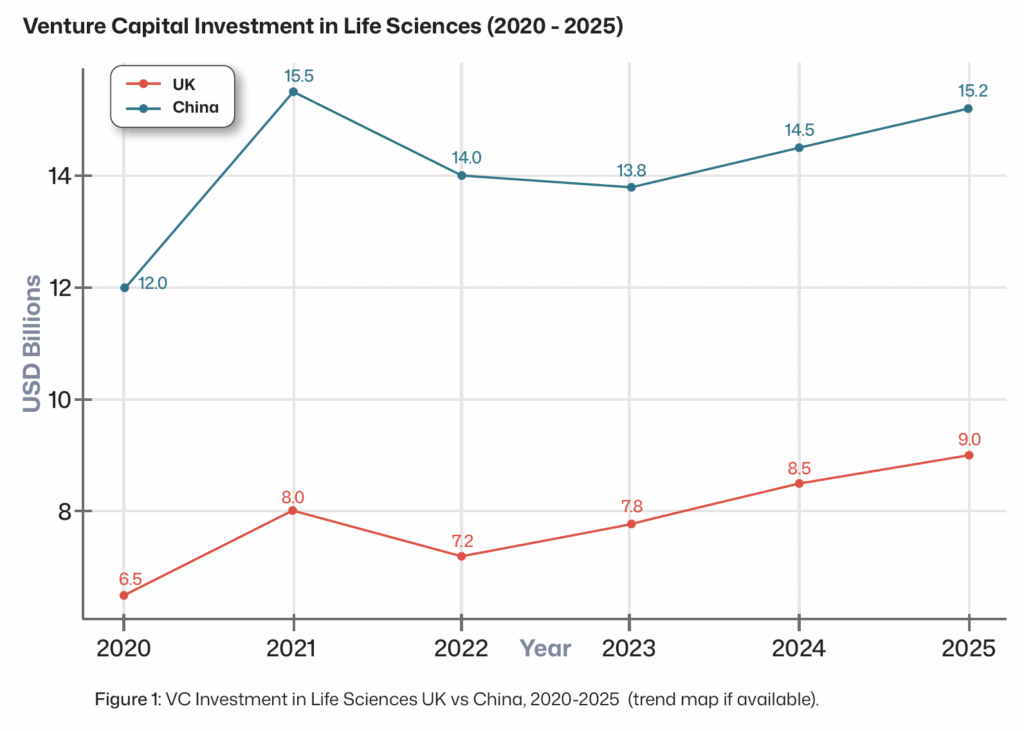
- UK: Venture capital funding is resilient, prioritising translational biotech and NHS-linked innovation.
- China: Despite macroeconomic headwinds, capital continues to seek internationalisation pathways, particularly in medtech and CRO partnerships. Strong but diverging development in biotech, medtech, and investment flows.
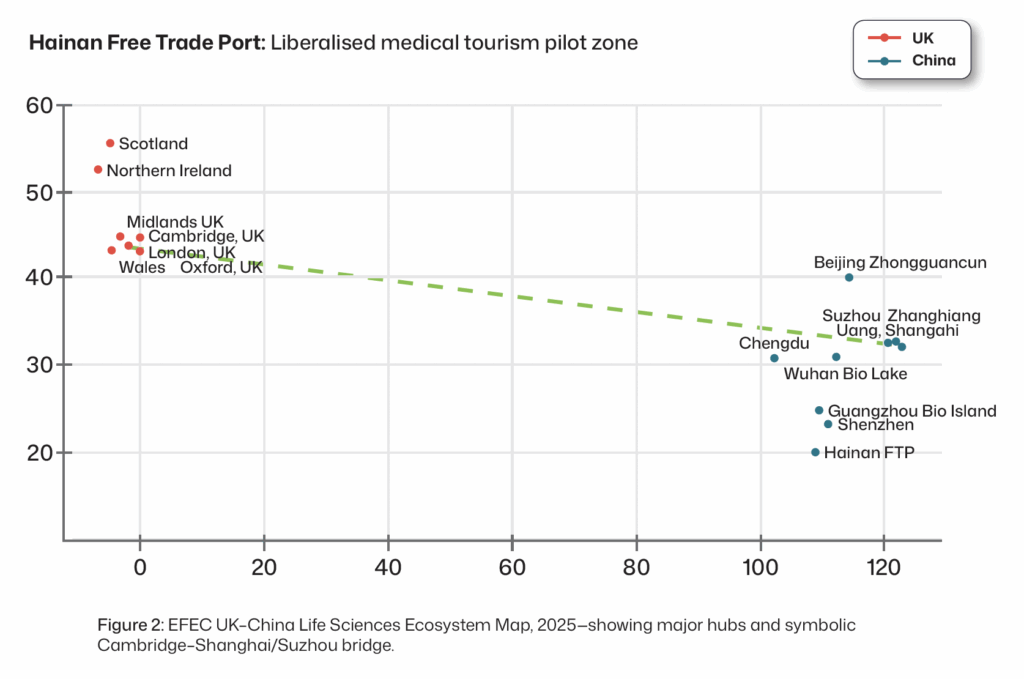
- Comparative cluster leadership: Cambridge, Oxford, London (UK); Shanghai, Suzhou, Beijing, Shenzhen, Guangzhou, Wuhan, Chengdu, Hainan (China).
2. Regulatory & Policy Updates
UK
MHRA’s Innovative Licensing and Access Pathway; NHS and NIHR pilot studies
China
NMPA ICH harmonisation, fast-track biotech pilots, and regional zones (e.g., Lingang, SIP)
UE
New EU AI Act, shaping digital health regulation and international alignment
3. Ecosystem Highlights
United Kingdom
Cambridge, UK:
Translational research, Cambridge Biomedical Campus, NHS integration.
Oxford, UK:
Vaccines, biotech spinouts, academic-industry clusters.
London, UK:
Capital markets, MedCity accelerators, health data innovation.
Midlands, UK:
Clinical trials & advanced manufacturing (Medilink Midlands as connector).
Scotland:
Precision medicine, drug discovery, imaging clusters.
Wales & Northern Ireland:
Growing medtech and health innovation hubs.
China
Shanghai Zhangjiang Hi-Tech Park:
China’s ‘Pharma Valley’, home to multinationals and CROs.
Shanghai Lingang Life Sciences:
Regulatory pilots and advanced manufacturing.
Suzhou SIP & BioBay:
Biotech powerhouse and SME incubator.
Beijing Zhongguancun:
Policy leadership, AI-biotech research, national hospitals.
Shenzhen Life Sciences Park:
Medtech, diagnostics, and digital health startups.
Guangzhou International Bio Island:
Diagnostics and biotech R&D.;
Wuhan BioLake: Post-pandemic biotech recovery, CRO services.
Chengdu Tianfu:
Pharma and medtech pipelines in Western China.
4. Cross-Cultural Factors in UK–China Life Sciences Innovation
Why Culture Matters:
Beyond regulation and technology, success in UK–China partnerships comes from deeply understanding each other’s ways of working:
Decision-Making: UK teams often emphasise transparency and consensus, preferring thorough documentation before formal engagement. Chinese stakeholders usually value early, in-person meetings to establish trust and respect, advancing rapidly through hierarchical decision channels.
Communication: Direct feedback is valued in UK practice; in China, indirect communication and the use of trusted intermediaries (“guanxi”) remain vital.
Risk, IP, and Commitment: The UK focuses on contracts and clear IP protections; China values trust, loyalty, and long-term personal relationships, but has made strong progress in strengthening IP laws and enforcement. Effective collaboration today can balance robust legal agreements with genuine relationship-building.
Collective Orientation: Personal networks and emotional connection often trump formal agreements in China. Winning trust early leads to lasting commitment.
Practical Example:
A UK company relied on EFEC, their trusted bridge, to handle introductions and relationship-building with Chinese partners, assuming this would be sufficient and save them time. However, while EFEC’s involvement established initial trust, the Chinese stakeholders still expected direct personal investment from the UK executives to build genuine guanxi. The limited personal engagement from the UK side was seen as transactional, slowing deeper partnership development until the UK team began investing more time and face-to-face effort themselves.
EFEC Insight:
“Win their heart over, and you will have them stick with you and face all the challenges ahead.”
Investing in relationship building—especially at the start—is the foundation for resilient, long-term partnership.
Tips for Success
- Nominate cultural champions.
- Invest in-person engagement.
- Clarify not just what you’ll do, but how you’ll work together.
5. EFEC Case Reflections & Practitioner Toolkit
- Lingang–Cambridge Network Dialogues: EFEC facilitated dialogue between UK innovators and Lingang pilot zone in Shanghai. While immediate outcomes were limited—particularly during the challenging pre-pandemic and pandemic years—the experience illuminated core barriers between UK translational research and China’s accelerated regulatory-commercial pathways. These insights now guide the Hub’s strategy for building durable, trust-based partnerships.
- Medilink Midlands Engagement: Since early 2024, EFEC has collaborated with Medilink Midlands to support SMEs in the region. By sharing international perspectives and identifying cross-border engagement opportunities with China, EFEC continually works with Medilink Midlands to strengthen growth pathways for UK companies pursuing global expansion.
- Expanding Sector conversations (2025): EFEC’s CEO, Lily Lin, attended the Oxford Med-Tech Fair as a visitor, engaging with exhibitors and organisers. As a Cambridge Network member, EFEC also contributed a thought-leadership post reflecting on UK–China life sciences trends from the event—demonstrating ongoing participation in the UK innovation ecosystem.
Thought Leadership Recognition: EFEC’s CEO, Lily Lin, is confirmed as a speaker at Mills & Reeve’s ‘Doing Business with China’ event (Feb 2026), alongside Barclays and academic leaders. This recognition underlines EFEC’s trusted role as an interpreter of cross-cultural business and innovation dynamics.
Practitioner’s Toolkit—Actionable Lessons:
Drawing from these experiences, UK founders and executives are encouraged to:- Prioritise early-stage, in-person relationship building with Chinese partners.
- Recognise and adapt to differing regulatory and commercial timelines.
- Leverage trusted intermediaries to navigate system mismatches, but also invest personal effort in developing genuine guanxi.
- Use lessons from past sector partnerships to shape flexible, culturally intelligent strategies for international market entry.
Founder’s Dual Strategy Playbook
UK → China
- Engage with NMPA regulatory pathways early
- Build data packages for local clinical priorities
- Identify pilot innovation zones (e.g., Lingang, Hainan)
- Prepare a robust IP strategy for dual protection; note recent progress in China’s IP enforcement
- Secure a trusted connector or intermediary (examples: EFEC, SIP, Medilink Midlands)
China → UK
- Understand NHS procurement and evidence cycles
- Engage early with MHRA ILAP pathway and relevant regulators
- Build market credibility through UK innovation networks (e.g., Cambridge Enterprise, MedCity, Medilink Midlands)
- Tailor communications on ethics, compliance, and governance
Note: Organisations listed above are examples of sector-leading hubs and trusted intermediaries. Their inclusion does not imply direct past or present collaboration with EFEC unless otherwise stated.
6. Reccomendations
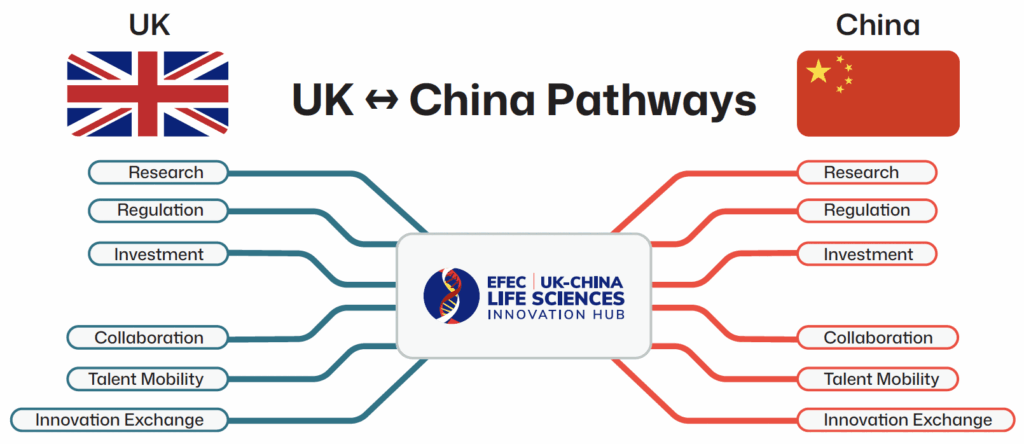
- Develop dual market pathways; anticipate, don’t react to, regulatory change.
- Partner with credible connectors.
- Prioritise cultural fluency and relationship-building for long-term results.
Conclusion
UK and China are not competitors, but natural complements in life sciences. By aligning ambition, excellence, and cultural intelligence, EFEC’s Innovation Hub translates vision into practice for real-world impact.
Download
Cross border life sciences report 2025
References
EFEC UK–China Life Sciences Innovation Hub. (2025). Insights from the UK Life Sciences Start-up Report: Building Bridges with China for Mutual Growth. Submitted to Cambridge Network, August 2025.
https://www.cambridgenetwork.co.uk/news/insights-uk-life-sciences-start-report-2025-building-bridges-china-mutual-growth
EFEC UK–China Life Sciences Innovation Hub. (2025). China at Now – An EFEC insight for the UK life sciences community. Published on Cambridge Network, May 2025.
https://www.cambridgenetwork.co.uk/news/china-now-efec-insight-uk-life-sciences-community
EFEC UK–China Life Sciences Innovation Hub. (2025). How UK–China collaboration can accelerate global biotech. Published on Cambridge Network, September 2025.
https://www.cambridgenetwork.co.uk/news/laying-tracks-how-uk-china-collaboration-can-accelerate-global-biotech-0
Medicines and Healthcare Products Regulatory Agency (MHRA). (2024–2025). Innovative Licensing and Access Pathway (ILAP). Official Guidance and Documents:
https://www.gov.uk/government/publications/innovative-licensing-and-access-pathway-ilap
National Medical Products Administration (NMPA). (2024). ICH Harmonization Updates.
Announcement: https://english.nmpa.gov.cn/2023-08/25/c_964026.htm
ICH Implementation Report (2024): https://admin.ich.org/sites/default/files/2024-10/ICHImplementationPublicReport_Final_2024_1001.pdf
European Commission. (2024). EU Artificial Intelligence Act.
Official Regulation: https://artificialintelligenceact.eu/the-act/
Legal Text (PDF and summary): https://ai-act-law.eu
Cambridge Biomedical Campus (2025). Innovation Impact Report.
https://cambridge-biomedical.com/wp-content/uploads/2024/09/CBC-VISION_updated_Sept24.pdf
https://cambridge-biomedical.com/wp-content/uploads/2024/08/CBC-Economic-Impact-Report-CEBR.pdf
Suzhou Industrial Park (2025). Cluster Overview and Sustainability Initiatives.
Case Study (Accenture): https://www.accenture.com/content/dam/accenture/final/a-com-migration/r3-3/pdf/pdf-147/accenture-wef-industrial-clusters.pdf
EFEC UK–China Life Sciences Innovation Hub. (2025). Building Bridges at the Oxford Med-Tech Fair: EFEC’s UK–China Life Sciences Vision. Published on Cambridge Network, September 2025.
https://www.cambridgenetwork.co.uk/news/building-bridges-oxford-med-tech-fair-efecs-uk-china-life-sciences-vision
EFEC UK–China Life Sciences Innovation Hub. (2024–2025). Internal interviews and project documentation.
Appendix: Disclaimer & Verification Note
Disclaimer Reminder
This report is for market insight and knowledge sharing only. It does not constitute legal, clinical, or investment advice. All data and references are verified as of October 2025; please consult official updates for the latest guidance.